Axum - Tigray
Axum, in its day, was a great commercial centre,issuing its own currency and trading with Egypt, Arabia, Persia, India and even Ceylon. The settlement was also the site of Ethiopia's oldest church, which dated back to the coming of Christianity as the state religion, early in the 4th Century. The original building has long since disappeared but a structure erected on its site by Emperor Fasiladas in the early 17th Century is still there. A nearby outhouse is the reputed repository of the biblical Ark of the Covenant.
This historic relic cannot be seen but visitors there can see and photograph a number of the remarkable crowns that belonged to several notable Ethiopian monarchs of the past. Just out of the town, the remains of an early Axumite palace, popularly thought to have belonged to the Queen of Sheba, are well worth a visit. The remains are located at Dangur, near the mountain from which the obelisks were originally excavated.
The beautifully worked tombs of several ancient Axumite rulers and the local archaeological museum are also worth a visit. About 45 per cent of the Ethiopian population is Muslim. Most of the Christians belonging to the Ethiopian Orthodox Church, whose 4th Century beginnings came long before Europe accepted Christianity.
Facilades - Gondar
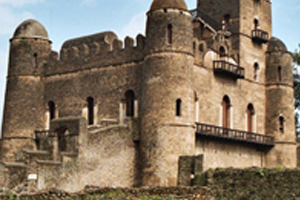
Ethiopia went through a long period without a fixed capital. When it was time to have one, there was no better settlement than the one at Gonder. Besides being the largest settlement in the country, it was an important administrative, commercial, religious, and cultural center. It was also noted for the skills of its many craftsmen. Gonder became the capital of Ethiopia during the reign of Emperor Faciladas (1632-1667).
Faciladas was responsible for the building of the fist castle-like palaces, the most magnificent of all the castles. In most European cases, the single castle such as the above would have been sufficient to serve as palace for successive generations. In Gonder however, it seems that each emperor built his own castle, ignoring those of his ancestors.Thus, additional castles were built by Faciladas's successors:
His son, Yohannes, added a chancellery and library. Iyasu built his own palace, which is said to have been the most orate of all. Bakaffa and his clever wife Mentewab, built castles surrounded by a massive crenellated wall with twelve gates at the center of the town. Iyasu II, the last of Gonderine kings, built his own palace to the west of the city. The defensive walls found around most castles are more for display rather than actually withstanding military assault.
Harar - Harar
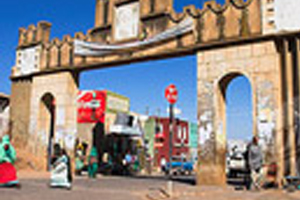
The city of Harar is an ancient (1520) and holy city. Always an important trading centre, the city is famous for its ancient buildings, its great city walls and as a centre of learning muslim scholarship ( the town has 99 mosques). The city is well known for its superb handicrafts that include woven textiles, basketware, silverware and handsomely bound books, Harar has been a place of pilgrimage from all over the world for many years.
Harar's attractions are The City Walls, The City Walls, and the narrow streets lined with traditional Hararigegar houses. Rimbaud House A Fine building traditional house dating from the period when the French poet Rimbaud lived in Harar. The Hyena Man As evening falls, local men attract wild hyenas to the city in a bizarre spectacle as they bravely feed these dangerous scavengers.
Lalibela - Wello
The fall of Axum resulted in 'Ethiopia forgetting the world, and being forgotten by the outside world'. A new dynasty, comprising of six kings and one queen, came to power in the Christian highlands, based in the Agew district of Lasta.
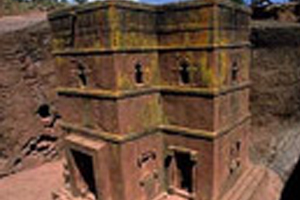
The Agew language was the result of long time cultural and political interactions between Cushitic and Semitic speaking peoples in the northern highlands. To fill the spiritual void created by the inability to go on pilgrimage to Jerusalem, King Lalibela, took it upon himself to construct 'New Jerusalem' here at home and built a number of churches. The churches were often modeled after Christian religious edifices in the Holy Land. The eleven churches at Lalibela, were excavated from solid rock with an immense underground maze of tunnels and passages.
There are two main groups of churches, with another church dedicated to Saint George a short distance away. The style is remarkably similar to the numerous rock-hewn churches of Tigray, but the sheer masterpiece in craftsmanship is quite wonderful. These churches were so perfect that they were considered by some as 'The eighth wonder of the world', and became one of UNESCO's world heritage sites.
Yeha -
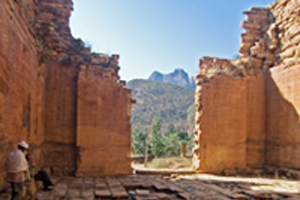
The oldest standing structure in Ethiopia is located in Yeha: the Great Temple. This is a tower built in the Sabaean style, and dated through comparison with dated structures in South Arabia to around 700 BC; although no radiocarbon dating testing has been performed on samples from Yeha, this date for the Great Tower is supported by local inscriptions.
David Phillipson attributes its "excellent preservation" to two factors, "the care with which its original builders ensured a level foundation, firmly placed on the uneven bedrock; and to its rededication -- perhaps as early as the sixth century AD -- for use as a Christian church."
Two other archeological sites at Yeha include Grat Beal Gebri, a ruined complex distinguished by a portico 10 meters wide and two sets of square pillars, and a graveyard containing several rock-hewn shaft tombs first investigated in the early 1960s. One authority has speculated that one of these tombs contained a royal burial, while another believes the ancient residential area was likely one kilometer to the east of the modern village.